
Overnight on August 21, Amazon changed the prices on its own hardware without announcing it. Fortune caught it first. The base Echo Dot went from $50 to $80 — a 60% increase, and the number that ended up in most headlines. But the across-the-board figure being reported is wrong, and the real spread is more revealing than the top line.
The Fire TV Stick HD rose from $35 to $40, about 14%. The Fire TV Stick 4K Max went $60 to $85, roughly 42%. The 16GB Kindle moved $110 to $150 (36%), the 16GB Kindle Paperwhite $160 to $200 (25%). The eero 7 three-pack went $350 to $400; the eero Pro 7 three-pack $700 to $800. The Echo Show 21 took a flat $100, from $400 to $500. At the other end, the Echo Show 5 and Echo Show 8 rose about 11% each. Ring devices were left alone entirely.
Amazon’s explanation was one sentence: the consumer electronics industry is facing significant increases in memory and storage component costs, which the company said it absorbed for as long as it could. That much is true. The more interesting question is why the increases land so unevenly, and why a company that has spent a decade refusing to charge for this hardware suddenly is.
The Subsidy Was the Strategy
In 2019, Dave Limp, then Amazon’s devices chief, described the model plainly: the company did not need to make money selling you the device, because it would make money when you used it. Echo speakers were sold at or near cost. The hardware was the on-ramp; Alexa, Prime, and the purchases that were supposed to follow were the business.
They largely didn’t follow. Reporting in 2022 put annual losses in Amazon’s devices and services division at around $5 billion, with most Alexa owners never buying anything through the assistant. The subsidy survived anyway, because a loss leader is only worth defending while the ecosystem it feeds is still growing.
Which is why a 60% increase on the cheapest Echo is the actual story here. A $30 jump on a $50 speaker is not cost pass-through at the margin. It is the abandonment of a pricing posture Amazon held for roughly ten years. The devices most exposed are the ones that were subsidized hardest.
This Is an Auction, Not a Broken Supply Chain
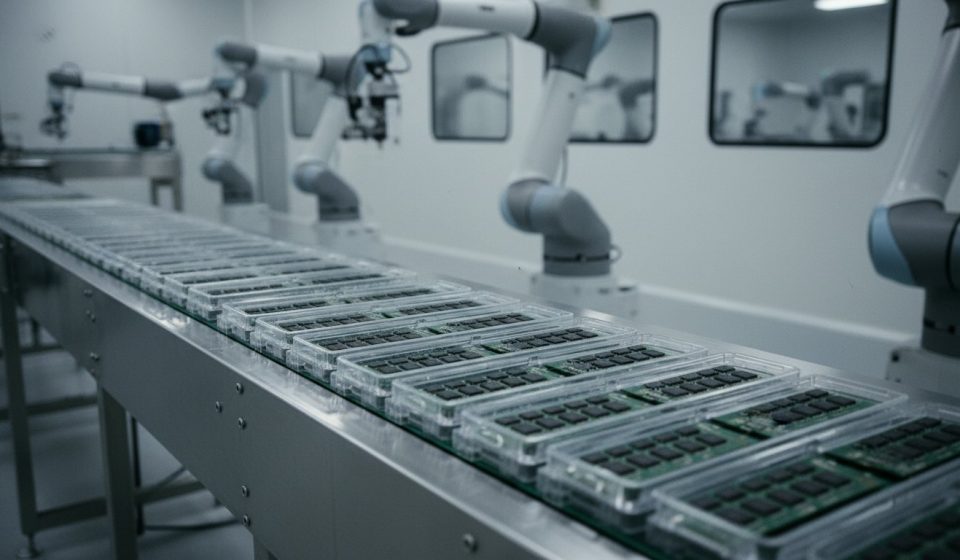
The reflex explanation — fragile global supply chains, just-in-time inventory, the lingering shadow of the pandemic — does not fit the facts. No fabs are shut. No container ships are stuck. Memory is not unavailable. It is expensive, because someone else is bidding more for it.
J.P. Morgan Global Research estimates DRAM prices will have risen more than 400% between the start of 2024 and the end of this year. TrendForce put conventional DRAM contract prices up 90–95% quarter-over-quarter in the first quarter of 2026, with a further 58–63% forecast for the second — which landed at roughly 60%. Those are not the price signatures of a logistics failure. They are the price signature of a capacity reallocation.
Samsung, SK hynix, and Micron have been steering wafer output toward high-bandwidth memory and server DRAM, where AI infrastructure buyers pay substantially more per wafer than a smart speaker ever will. Hyperscalers are locking that output down through long-term agreements running five years and longer. Meta raised its capital expenditure guidance by $10 billion, citing higher AI hardware and memory costs directly. Micron does not expect meaningful new supply before 2027, and SK hynix has signalled the shortage could run as far out as 2030.
The distinction matters because it determines what, if anything, fixes it. Diversifying suppliers is the standard prescription, and it is useless here: there are three major DRAM makers and all three are making the same entirely rational choice. Second-sourcing does not help when every source is selling to a higher bidder. Neither does stockpiling, unless you bought two years ago.
The First Sign of a Ceiling
One thing has changed since the repricing, and it is not supply. TrendForce now projects conventional DRAM contract prices rising 13–18% quarter-over-quarter in the third quarter, with NAND up 10–15%. Still climbing, but a sharp deceleration from roughly 60%.
The stated reason is worth reading carefully. No new fabs came online. Server DRAM remains undersupplied. What changed is on the buy side: TrendForce says customers in consumer markets — PCs and smartphones — are reaching their affordability limit, and long-term agreements are capping what hyperscalers pay on the rest.
Amazon’s repricing is that limit made visible at the checkout. It is the moment a manufacturer stops absorbing and starts passing through. The deceleration in contract prices is not relief arriving; it is demand being destroyed at the bottom of the market while the top keeps buying.
Amazon Is on Both Sides of This Trade
There is an awkward symmetry in Amazon of all companies issuing this statement. AWS is one of the hyperscalers whose data center buildout is doing the bidding. The same demand that makes Amazon’s cloud business the most valuable part of the company is what has priced Amazon’s devices business out of its own components.
Internally that nets out fine — AWS margins dwarf anything the Echo line ever produced, and given the division’s losses, allocating scarce memory to servers rather than speakers is the correct call. It is simply a transfer, from the part of Amazon that gives hardware away to the part that rents it out. The customer buying an Echo Dot for $80 is on the losing side of an internal reallocation, not a shipping crisis.
It Is Already in the Inflation Data
This has escaped the consumer electronics aisle. The producer price index for storage devices is up 23% since the end of 2024, as is the CPI for software and accessories; the import price index for computers, peripherals, and parts is up 37%. J.P. Morgan’s rule of thumb is that every 10% rise in hardware costs adds roughly 0.1 percentage points to core CPI and PCE inflation, and it attributes a 0.2 to 0.4 point lift to the memory shock alone.
Apple, Roku, and other device makers face identical component math, and Amazon moving first gives the rest of the industry cover to follow. Watch whether they do it before the holiday quarter or after it — that timing will tell you whether they believe the affordability limit TrendForce is describing has already been hit.
The lesson is not that supply chains need to be more resilient. It is that consumer hardware was quietly cross-subsidized for a decade, by cheap memory and by companies willing to lose money on the box, and both of those subsidies expired at once.
Get the weekly briefing
One email a week on AI, infrastructure, policy and the supply chains underneath them. Free, and you can unsubscribe any time.