
The Action
On August 21, 2026, the President announced on Truth Social that he had arranged to bring down ground beef prices by importing up to 300,000 metric tons of it. The proclamation memorialising that announcement was signed on August 26.
The mechanics are narrower than the announcement. It adds 300,000 metric tons of lean beef trimmings — HTS lines 0201.30.5091, 0201.30.5097, 0202.30.5091 and 0202.30.5097 — to the 2026 tariff-rate quota, letting them enter at the in-quota rate rather than the 26.4% out-of-quota duty. It runs in three tranches of 100,000 metric tons on a first-come, first-served basis: September 1–30, October 1–30, and October 31 through November 30. The authority cited is Section 404 of the Uruguay Round Agreements Act, Section 604 of the Trade Act of 1974, and Section 301 of Title 3.
Crucially, the volume is allocated to the “other countries or areas” category — the residual bucket whose 2026 limit Brazil had already exhausted back in January. It is not Argentina’s. Argentina got its own expansion in February: a separate proclamation temporarily quadrupled its allocation, adding 80,000 metric tons in quarterly 20,000-ton tranches on top of a 20,000-ton base, at an in-quota duty of $44 per metric ton. Argentine beef has averaged under 2% of US beef imports since 2018. The two actions are frequently reported as one thing. They are not.
Why Beef Got Expensive
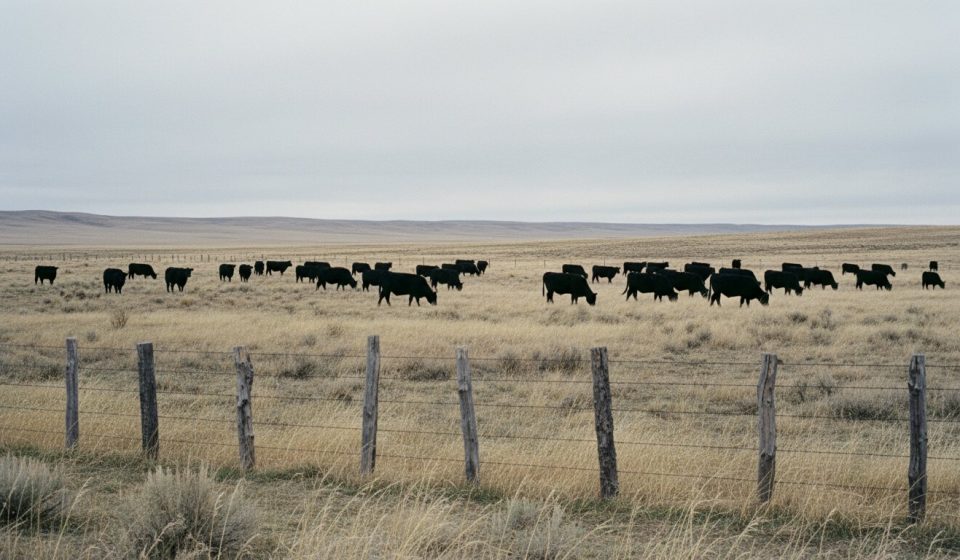
The proclamation’s own finding is the honest version of the story: supply “will be inadequate to meet domestic demand at reasonable prices,” because “the United States herd has fallen to its lowest level in 75 years.”
USDA’s January 30, 2026 Cattle report puts hard numbers on that. Total cattle and calves: 86.2 million head, down 0.35% year over year and the smallest herd since 1951. Beef cows: 27.6 million, down 1%. The 2025 calf crop: 32.9 million, down 2% and the smallest since 1941. Since the last cyclical peak in 2019, the national herd has shrunk by roughly 8.5 million head — about 9%.
Prices followed, as they must. BLS average price data has ground beef at $6.885 per pound in July 2026, against $6.254 a year earlier and $5.497 in July 2024. That is up 10% in twelve months and 25% in twenty-four.
Run the Arithmetic
Here is where the announcement and the effect diverge. Purdue’s Center for Commercial Agriculture worked the numbers: 300,000 metric tons is about 661 million pounds, or roughly 6.8% of one year’s ground-beef supply. Compressed into 90 days it sounds enormous. Measured against annual consumption it is a rounding error with a press release.
Their conclusion is blunt. Even a very favourable realisation of the full announced volume would move average retail ground-beef prices by well below 1%.
And that estimate is generous, because the 300,000 tons is a ceiling on eligible entry, not a promise of additional supply. Some share of it is beef that would have crossed the border anyway and now simply crosses more cheaply. That difference accrues to importers and processors, not automatically to the person at the meat counter. The waiver reduces a landed cost. Whether that reaches retail depends on margin behaviour through a supply chain the proclamation does not touch.
The Contradiction Nobody Is Naming
There is a real tension buried in this policy, and it is a cattle-cycle problem.
Rebuilding the herd requires ranchers to retain heifers rather than sell them. That is an expensive decision: you forgo revenue today for a calf that reaches market in roughly two years, in exchange for a price you cannot know. Producers make that bet when they are confident prices will stay strong. USDA’s January report showed beef replacement heifers at 4.71 million head, up 1% — a flicker of retention, not an expansion.
Cheap imported trimmings arriving precisely during that fragile decision window cut against it. Analysts split on this after the February Argentine action, some calling the effect negligible, others warning that softer import prices discourage exactly the herd rebuilding that would fix the underlying shortage. Import waivers treat the symptom on a 90-day clock. The disease runs on a multi-year biological cycle, and the two timelines are not compatible.
What to Watch
- Tranche fill rates. First-come, first-served makes these a live demand indicator. If September’s 100,000 tons clears in days, the import appetite is real. If tranches go unfilled, the binding constraint was never the tariff.
- USDA’s January 2027 Cattle report. Beef replacement heifers is the number that matters. It is the only public signal of whether producers are actually rebuilding.
- The 90-day expiry. The waiver ends November 30. Whether it is extended will say more about the policy’s real objective than anything in the proclamation’s findings.
If you are watching this as a market story rather than a grocery story, ignore the retail ground beef price over the next three months — it will be dominated by cattle futures and seasonal demand, and the waiver’s contribution will be too small to isolate. Watch the heifer retention number instead. That is the only thing that ends this, and it will not report until 2027.
Get the weekly briefing
One email a week on AI, infrastructure, policy and the supply chains underneath them. Free, and you can unsubscribe any time.