
On 26 August, a county board in the Arizona desert did something the AI buildout is not used to: it said no. Pinal County’s supervisors voted 4-1 to deny the rezoning behind La Osa, a data center and gas generation campus south of Eloy — the first data center campus ever proposed in that county.
What makes this worth studying is not that a project with no numbers got refused. It is that this one had numbers by the end, and lost anyway.
What Was Actually on the Table in August
The application the board voted on was not the one it received. In late May, facing sustained opposition, Vermaland’s attorney told supervisors the owner wanted to make the project smaller, and the board agreed to revisit it on 26 August.
The reduction was drastic — roughly 80%. The conceptual build-out went from 59 data center buildings to 11. Total energy demand was capped at 1 gigawatt, down from an original 3 GW. On-site generation was specified: a 500-megawatt natural gas plant, plus utility-scale battery storage. Vermaland offered a 600 acre-foot cap on fresh water — about 200 million gallons — covering both the data center buildings and the gas plant, and said it would consider buying effluent to offset some of that, without committing.
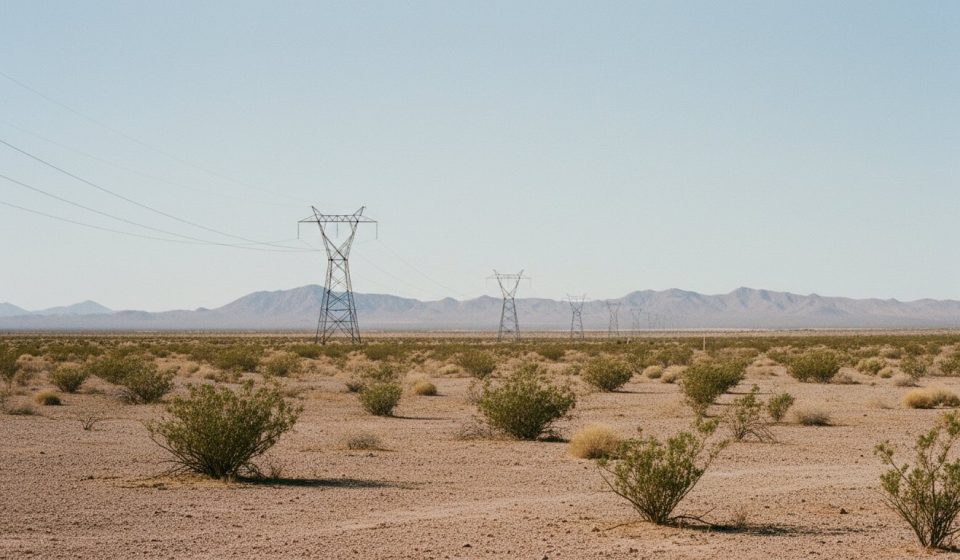
The rezoning itself still covered 3,385 acres, split into 2,393 acres of I-3 industrial and 992 acres of proposed open space, under case numbers PZ-003-26 and PZ-PD-003-26, the latter a Planned Area Development overlay carrying 33 stipulations. Two 115 kV Western Area Power Administration lines already bisect the site, with a 230 kV line to the south.
So the board had a megawatt figure, a demand ceiling, a water cap and a self-imposed 80% haircut. It still voted no.
The Missing 500 Megawatts
Here is the arithmetic that did the damage. The campus was capped at 1 GW of demand. The on-site gas plant would supply 500 MW. That leaves 500 MW to come from somewhere else, and supervisors asked where.
The answer was unsatisfying. Nearby solar resources, they were told, were already dedicated to other companies. A project that has published a demand ceiling but cannot say how it will meet half of it has not actually resolved the question the disclosure was supposed to answer — it has relocated it.
That is a different failure from vagueness, and a more instructive one. Numbers are not the same as a plan. A 1 GW cap is a promise about consumption; it says nothing about supply, and in a county with two existing transmission lines and a fully spoken-for solar pipeline, supply was the binding constraint all along.
Why the Earlier Rounds Still Mattered
The other thing the record shows is that late disclosure does not repair early credibility.
Planning and Zoning Commissioner Karen Mooney pointed to incomplete information and inaccurate job and economic impact data in the earlier applications. The original rezoning narrative had leaned on unquantified superlatives — thousands of jobs, billions in tax revenue to local taxing districts, tens of billions in local investment — while deferring every hard number. Generation size would be settled later with the local electrical district. Building count would be “determined by the market demand with a maximum of 59.” Water was listed as a private well, to be turned over to Global Water as development grew; sewer was septic.
By August most of those blanks had been filled. But a board that has been asked once to approve a project sight unseen tends to read the second submission differently, and the turnout reflected it: the county ran five overflow rooms across three buildings, with residents raising water, air quality, noise, wildlife and property values.
The dissent deserves stating fairly. Supervisor Stephen Miller voted against denial, arguing that individuals have a right to use their property as they wish and framing data centers as a matter of national defence.
Virginia Wrote the Questions Into the Code
The day before the Pinal vote, on 25 August, the Henry County, Virginia board took the opposite route and made disclosure a condition of applying.
Its new Data Center district requires a third-party water supply impact study covering demand, cooling technology, water sources, groundwater analysis, cumulative impacts, drought modelling, recycling and wastewater. It mandates closed-loop cooling and prohibits evaporative cooling and cooling towers. It sets a 1,000-foot setback from any non-industrial property and a 50 dBA ceiling at the exterior property line, with a third-party acoustical analysis modelling worst-case conditions including peak cooling and generator testing, post-construction testing within 90 days, and annual testing for the life of the facility. Decommissioning provisions and electrical infrastructure requirements sit alongside.
Two counties, one fortnight, two theories of the same problem. Henry County put the questions in the ordinance so every applicant answers them before a hearing. Pinal had no such rule, so the only instrument available to supervisors who wanted certainty was refusal.
The Record Is a Five-Hour Video
Pinal County publishes its board meetings on YouTube. The recording of the 26 August session runs 4 hours, 58 minutes, 58 seconds, with the La Osa cases at the top of the agenda. It has been viewed 466 times. The county’s published board minutes currently stop at 5 August, so that recording is the primary public account of how a 1 GW project was decided.
Chip supply, interconnection queues and power purchase agreements get modelled to three decimal places. The gate that actually stopped this one was a rural county board on a Wednesday morning, and the deciding question was where half the electricity would come from.
What to Watch
- A refile is the base case. The comprehensive plan amendment redesignating the land for Employment and public facilities was approved separately and was not overturned. The land still carries that designation.
- Whether the next application answers the supply question. Not the demand cap — the 500 MW gap. A signed power arrangement, not a projection, is what changes this vote.
- Whether Pinal writes its own rule. Residents left the hearing asking for regulations rather than case-by-case fights, which is the Henry County model.
If you track data center siting, the useful habit just got narrower. Pull the applicant’s load figure, then check it against a named source of supply. La Osa disclosed what it would consume and still could not say who would generate half of it — and that gap, not the acreage or the building count, is what a board can refuse on.
Get the weekly briefing
One email a week on AI, infrastructure, policy and the supply chains underneath them. Free, and you can unsubscribe any time.