
Two Decisions That Do Not Fit Together
Military Sealift Command announced in late 2024 that it would move up to 17 ships into extended maintenance or planned inactivation, and began executing it the following year. By February 2025 the number actually sidelined stood at 14, with the command noting the figure would fluctuate. The list is twelve Spearhead-class expeditionary fast transports, two Lewis and Clark-class dry cargo and ammunition ships, two forward-deployed expeditionary sea bases and one fleet replenishment oiler. The reason is not that the ships are unneeded or unseaworthy. It is that MSC cannot crew them.
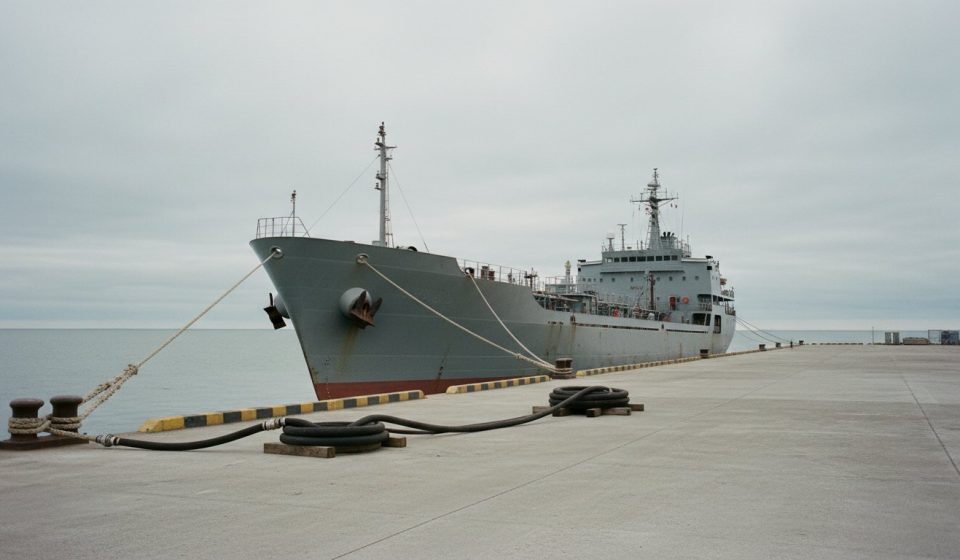
In June 2026 the Navy went looking for ten commercial tankers — medium-range hulls of at least 230,000 barrels capacity — to expand its logistics fleet, a solicitation run through the newly established Portfolio Acquisition Executive Maritime office, on a three-to-eight-year horizon for design and shipyard capacity.
Read those two facts next to each other and the shape of the problem appears. The service is taking ships out of service to free up sailors, and buying more ships that will need sailors. Steel is the part of this you can order. The people are not.
The Manning Arithmetic
MSC crews the Navy’s logistics and support fleet with roughly 5,500 civil service mariners against about 4,500 billets. That sounds like a surplus. It is not.
The metric the command actually manages to is the manning ratio — mariners per billet, which determines whether anyone ever gets to go home. MSC was running at about 1.27 as of February 2025 — which, as Rear Adm. Philip Sobeck described it, means four months at sea, one month off, then back to work. The command does not state its target as a ratio; it states it as a fill rate, 95 percent manning on tasked ships. Sidelining the 17 returns 600 to 700 mariners to the pool and lifts the ratio to 1.75 across the reduced fleet, which is how the two numbers connect.
At 1.27, a mariner is close to permanently deployed. That is the mechanism behind the retention problem, and it is self-reinforcing: short crews mean longer rotations, longer rotations drive people out, and their departure shortens the crews further. The 17-ship decision is an attempt to break that loop by shrinking the denominator, and it was calibrated to reach 95% manning on what remains.
It is a rational move. It is also an admission that the fleet on the books is larger than the fleet that can be operated.
What the Oiler Fleet Actually Is
Fuel is where this bites hardest, because nothing else the Navy does works without it.
As of May 2025, MSC had 14 Kaiser-class fleet replenishment oilers operational, each able to deliver on the order of 50,000 to 70,000 barrels a day of JP-5 and F-76 under wartime surge conditions. The replacement John Lewis class is arriving slowly — five hulls delivered and ten procured through FY2025 against 20 planned, with a sixth due in the summer of 2026 and similar daily throughput.
That is a thin margin for a fleet running distributed operations across two oceans. Take two or three Kaiser hulls out simultaneously for maintenance or inactivation and daily fuel throughput drops below what sustained operations require. The Navy has leaned on consolidated replenishment — CONSOL, drawing fuel from commercial tankers into its own oilers, a practice it has used since 2015 — precisely to cover that gap. The ten-tanker solicitation extends that workaround.
The logic is sound as far as it goes. A commercial tanker can be crewed commercially and keeps warships out of foreign ports during a conflict. But it does not resolve the underlying shortage, and it adds hulls to a command that is currently parking hulls for lack of people.
What Is and Is Not Established
This is where the popular version of the story needs handling with care.
Reports circulated from April 2026 onward, largely from the families of sailors, describing food shortages, thin meals, and later mould in showers and shortages of soap and toothpaste aboard USS Abraham Lincoln and USS Tripoli during an extended Middle East deployment.
The Navy has denied it. Adm. Daryl Caudle, the chief of naval operations, pushed back publicly on 20 April 2026, saying ships in the Abraham Lincoln Carrier Strike Group carried at least a 10-day supply of food and that many carried 30 days or more. Snopes examined the material in April and returned to it in August without arriving at a verdict either way.
Treat those accounts as contested, because they are. Family reports of conditions aboard a deployed warship are not nothing, but they are not verified, and the service has flatly contradicted them.
What is not in dispute is the deployment length — for the Lincoln. She left San Diego on 21 November 2025 for what her crew was told would be six months, made one port call in Guam in mid-December, and by late August 2026 had been at sea more than 250 consecutive days; on 12 September she reaches 295 days, the second-longest carrier deployment in decades, behind the Gerald R. Ford’s 326. Tripoli’s patrol was an ordinary six months — it returned to Okinawa on 22 July 2026 — so the endurance argument rests on the Lincoln alone. That figure requires no whistleblower and no photograph, and it is the more damning number, because a deployment of that length is what a fleet does when it does not have enough hulls and crews to rotate.
Why This Is a Supply-Chain Story
Strip the flags off and this is a familiar problem to anyone who runs a logistics network.
An organisation with a capacity constraint in one node — crewed vessels — responds by ordering more capacity in the adjacent node, because that node has a purchase order attached and the constrained one does not. Hulls have shipyards, budgets and appropriations. Credentialed mariners have a training pipeline measured in years, a commercial sector competing for the same people, and no procurement line item that produces them faster.
The maritime workforce shortage is not confined to the Navy. It runs across the US-flag commercial fleet, and the two compete for the same finite pool. Buying ten more tankers does not create the crews to run them; it enlarges the claim on a pool that is already short.
What to Watch
- The manning ratio, not the hull count. If MSC holds near 1.75 on the reduced fleet and converts it into the 95 percent fill rate it has been chasing since 2025, the recovery is real. If the ratio slides back toward 1.27 while the fleet grows, the sidelining will repeat with a larger number attached.
- Whether the 17 ships come back. Extended maintenance is reversible; planned inactivation usually is not. Which of the two it turns out to be will say whether this was a pause or a quiet reduction in force.
- John Lewis-class deliveries against the 20-ship plan. Five delivered of twenty is early. The replacement rate versus Kaiser-class retirements determines whether fuel throughput holds.
The useful takeaway generalises past the Navy. When an organisation announces a purchase in response to a shortage, check whether the thing being bought is the thing that was actually scarce. Here it is not, and the tell is that the same command is simultaneously parking ships it already owns.
Get the weekly briefing
One email a week on AI, infrastructure, policy and the supply chains underneath them. Free, and you can unsubscribe any time.