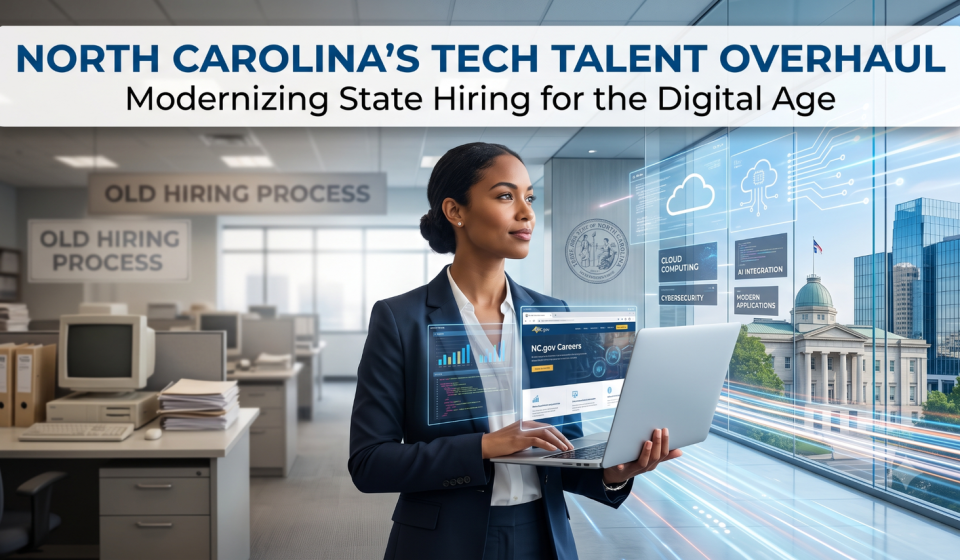
North Carolina’s Tech Talent Overhaul: Modernizing State Hiring for the Digital Age

North Carolina’s Tech Talent Overhaul: Modernizing State Hiring for the Digital Age
For decades, “government efficiency” has often felt like an oxymoron, especially regarding hiring. Picture bureaucratic hurdles, mountains of paperwork, and processes seemingly unchanged since the advent of the typewriter. But in a significant move, North Carolina is overhauling six decades of entrenched procedures, embarking on a mission to modernize its state hiring practices, starting with its critical IT sector.
This isn’t just about tweaking a few forms; it’s a systemic overhaul bringing the public sector into the 21st century. The state’s human resources director stated her office is adopting “tech best practices” to revamp how North Carolina recruits and retains talent. This announcement resonates with anyone who has applied for a public sector job or understands technology’s vital role in modern governance.
The Sixty-Year Freeze: Why Government Hiring Stalled
Government hiring is notoriously complex. Unlike the private sector, public agencies navigate a labyrinth of civil service rules, legislative mandates, and a crucial prioritization of fairness and equity, which can inadvertently slow the process. Compounding this is fierce competition from private tech companies offering higher salaries and more agile work environments, leading government IT departments to face a perpetual uphill battle for top talent.
The consequences of this stagnation are profound. Outdated hiring leads to slower service delivery, reliance on legacy systems that are costly to maintain and insecure, and a general inability for government to keep pace with citizen expectations in a digital age. When skilled IT professionals cannot be hired quickly, the state’s digital infrastructure inevitably suffers, impacting everything from unemployment claims processing to public safety systems.
“Tech Best Practices”: What Does That Actually Mean for Public Service?
The term “tech best practices” in this context is not merely buzzwords. It signals adoption of principles long standard in the private tech world:
- Streamlined Digital Workflows: Moving from paper applications and manual reviews to integrated Applicant Tracking Systems (ATS) that automate initial screening, scheduling, and communication.
- Data-Driven Recruitment: Using analytics to understand candidate sources, in-demand skills, and how to optimize outreach. This could include AI-powered tools for resume analysis (with careful bias mitigation).
- Enhanced Candidate Experience: Making the application process user-friendly, transparent, and efficient, ensuring qualified candidates do not abandon applications due to frustration or lengthy waits.
- Skills-Based Hiring: Shifting focus from traditional credentials to demonstrable skills, particularly relevant in fast-evolving tech fields where certifications and practical experience might outweigh a specific degree.
- Employer Branding: Actively marketing government careers as opportunities for impact and innovation, rather than solely stable employment.
By starting with IT positions, North Carolina is making a strategic choice. IT roles are often the most difficult to fill in government due to market competition, and they are foundational for modernizing other state departments. If the state can successfully streamline IT hiring, it establishes a template for broader reform across all public service roles.
A Blueprint for Other States
North Carolina’s initiative offers a vital blueprint for other states grappling with similar challenges. The shift isn’t merely about adopting new software; it’s about a culture change. It requires leadership commitment, investment in training for HR staff, and a willingness to dismantle entrenched processes.
- Improved Public Services: Faster, more accessible digital services for citizens.
- Enhanced Cybersecurity: A stronger team to defend against ever-present cyber threats.
- Greater Innovation: The ability to implement cutting-edge solutions for complex public problems.
- Fiscal Responsibility: Reducing reliance on expensive contractors by building in-house expertise.
This journey will undoubtedly face obstacles. Budget constraints, the inertia of large organizations, and the sheer volume of applicants for state jobs will test North Carolina’s resolve. Ensuring new systems remain equitable and do not introduce new forms of bias will also be paramount.
The Frontier of Public Sector Tech
At WiredFrontier, we often spotlight how technology is reshaping industries. Government, though sometimes slow to adopt, is no exception. North Carolina’s move is a powerful reminder that the infrastructure of public service—its human capital—is just as critical as its digital networks or physical roads. Modernizing how states attract and retain talent isn’t merely an administrative tweak; it’s a foundational step towards building a truly responsive and resilient government for the digital age.
This isn’t about replacing human judgment with algorithms, but about empowering HR professionals with tools that accelerate decision-making, broaden talent pools, and ultimately ensure that those serving the public are the best and brightest available. If North Carolina succeeds, it will not just improve its own operations; it will set a new standard for public sector excellence nationwide.
Get the weekly briefing
One email a week on AI, infrastructure, policy and the supply chains underneath them. Free, and you can unsubscribe any time.