Canada’s New $750M Export Terminal Fixes a Real Problem. Replacing US Trade Isn’t It.

What Actually Opened
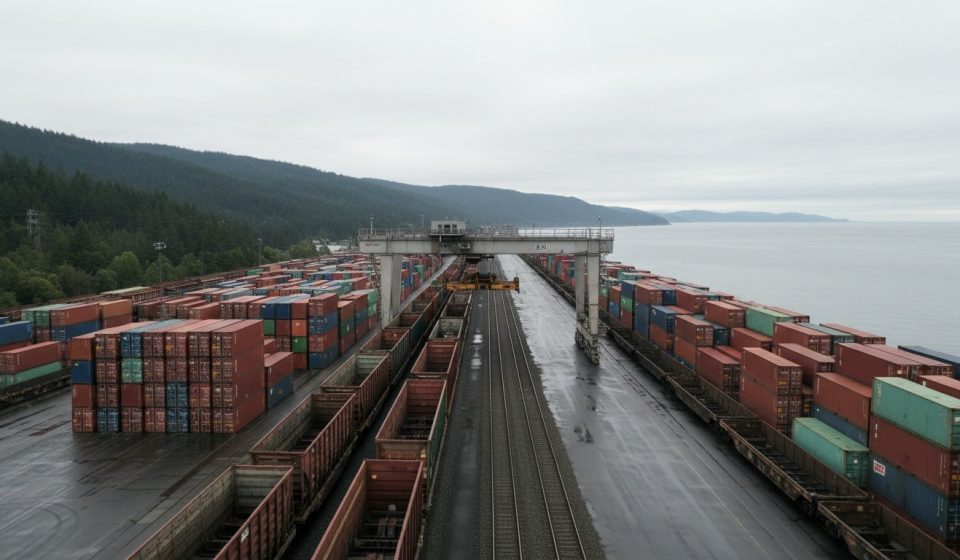
On August 27, 2026, the Port of Prince Rupert opened CANXPORT, a $750-million rail-to-container transloading facility on Ridley Island. It is designed to handle 400,000 TEUs a year in its first phase, with room to reach 750,000 — roughly six million tonnes of product annually.
The commodities are unglamorous and specific: petrochemical resin, cereal grains, specialty agricultural crops, lumber, pulp and mineral concentrates. Montreal-based Ray-Mont Logistics operates it. The supporting rail work matters as much as the terminal — the Ridley Island road-rail-utility corridor was widened to accept 10,000-foot trains with direct CN access, and CN upgraded the nearby Zanardi Rapids Bridge to carry the traffic. Construction started in October 2023 and ran to about 250 person-years of labour.
By 2030 the port expects CANXPORT to carry roughly 65% of its containerised exports. It is the first completed piece of a gateway expansion programme in the region running to about $3 billion.
That is a genuinely significant piece of Canadian infrastructure. It is not a replacement for American trade with Asia, and the arithmetic says so bluntly.
The Scale Problem
Prince Rupert is Canada’s third-largest port. It moved 26.3 million tonnes of cargo in 2025, up 14% year over year, and DP World’s Fairview Container Terminal handled 885,797 TEUs, up 20%.
Now the comparison. In 2025 the Port of Long Beach moved 9.9 million TEUs and the Port of Los Angeles 10.2 million — a combined 20.1 million through San Pedro Bay alone.
CANXPORT’s first-phase capacity is 400,000 TEUs. That is about 2% of what two Southern California ports handled last year, and it is export capacity specifically — a different flow from the import gateway that US retailers depend on. Even at the full 750,000, and even added to Fairview’s existing throughput, Prince Rupert is not in the same weight class. A facility does not displace a trade lane twenty-five times its size by opening.
The Problem It Does Solve Is More Interesting
Strip away the geopolitics and CANXPORT is an answer to a specific, expensive inefficiency: the empty backhaul.
Prince Rupert built its reputation as an import gateway. Containers arrive full from Asia at Fairview, get railed inland by CN, and the boxes then have to get back to Asia. Repositioning an empty container is pure cost — you pay to move air across an ocean. Meanwhile Canadian grain, pulp and resin producers in the Prairies and interior BC have historically struggled to get containers at all, because the boxes were somewhere else, or because loading them meant a truck detour to a distant transload yard.
CANXPORT puts the transload on the dock. Product arrives by rail in bulk, goes straight into a container that was going to sail east anyway, and leaves. The empty becomes revenue. That is why the capacity is quoted in both TEUs and tonnes — the facility is a conversion point between two forms of freight, not a new berth.
For a Saskatchewan pulse exporter, that is a material change in market access. It is not a change in where American consumer goods enter North America.
Where the Trade Story Is Actually Live
There is a real strategic argument in the neighbourhood of the hype, and it is worth stating precisely rather than inflating.
Canada is, by explicit government policy and against the backdrop of a bruising tariff fight with Washington, trying to route more of its trade through channels it controls end to end. A $3-billion gateway programme on the northwest coast, aimed at Asian markets, is that policy in concrete. Prince Rupert’s geography helps: it is the closest North American port to Asia, and CN gives it a single-railroad run inland.
What that buys Canada is optionality — the ability to move commodities to Asian buyers without transiting US infrastructure or US customs. That is a hedge, and hedges are valuable precisely when your largest trading partner is unpredictable.
But optionality is not substitution. Roughly three-quarters of Canadian merchandise exports still go to the United States, and one export terminal on Ridley Island does not move that number. Nor is CANXPORT aimed at the transpacific consumer-goods trade that Los Angeles and Long Beach exist to serve.
What to Watch
- Utilisation, not capacity. 400,000 TEUs is a design figure. The number that matters is how many containers actually move through it in 2027, and whether the port’s 65%-of-exports-by-2030 projection survives contact with grain prices and shipping rates.
- Whether phase two gets funded. The step from 400,000 to 750,000 is the test of whether demand is real or whether this was built ahead of it.
- Fairview’s import volumes. If Prince Rupert’s import business keeps growing alongside exports, the port is genuinely scaling. If imports flatten while exports rise, the empty-container fix worked and nothing larger changed.
If you ship Canadian commodities, this is a real new option and worth pricing against your existing Vancouver or US Gulf routing. If you are trying to read the North American trade war from it, the honest reading is smaller: Canada spent $750 million buying itself a door it does not have to ask permission to use. That is prudent. It is not a replacement.
Get the weekly briefing
One email a week on AI, infrastructure, policy and the supply chains underneath them. Free, and you can unsubscribe any time.