
A Correction Nobody Reported
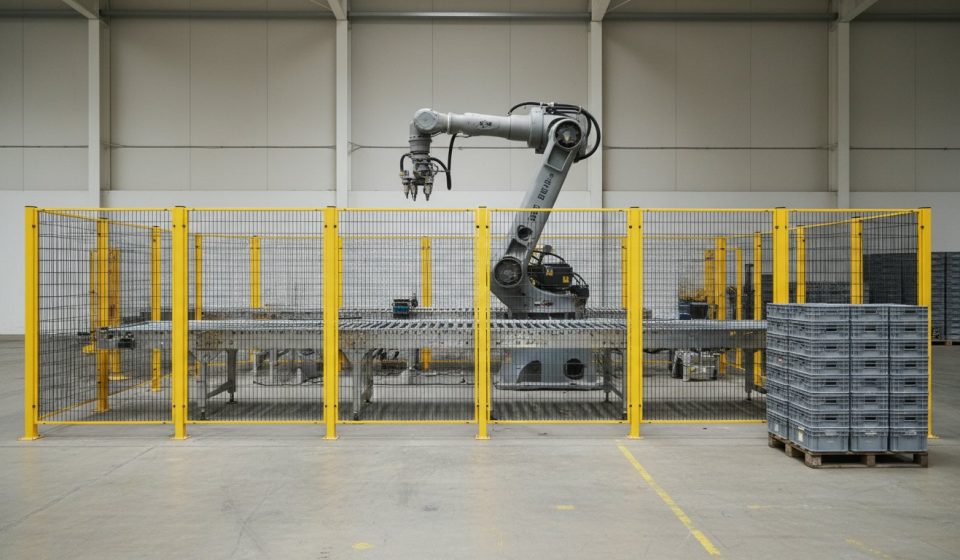
In October 2025, Amazon announced Blue Jay, a warehouse robotics system that coordinates several robotic arms at once and collapses what had been three separate robotic stations into a single workspace. The trade press covered it heavily. It was pitched as a step change in fulfilment automation, and the specifications supported that: Blue Jay could pick, stow and consolidate roughly 75% of the item types Amazon stores, and it had gone from concept to production in just over a year, against three or more years for the company’s earlier systems.
Amazon’s announcement page is still live. At the top of it now sits an update dated 25 February 2026: “Amazon is no longer utilizing Blue Jay in operations. However, the underlying technology used to develop the program will continue to support employees across our network.”
That is the entire disclosure. Two sentences appended to the original post, four months after launch. No press release, no blog entry, no earnings-call mention framed as a retirement.
What Was Actually Announced
Blue Jay was one of two systems unveiled together. The other, Project Eluna, is an agentic AI model that reads operational data, anticipates bottlenecks and recommends actions to facility managers — piloted at a fulfilment centre in Tennessee for the holiday season. Blue Jay was being tested in production at a facility in South Carolina.
The pairing matters, because only one of them was retired. Eluna is a software layer that advises humans. Blue Jay was physical hardware that replaced workstations. The system that came out was the one with steel in it.
Amazon also used the announcement to state that it was actively hiring, with 250,000 seasonal positions to fill. That framing — automation and hiring announced in the same breath — is worth remembering, because it is the frame that survives in the coverage after the hardware is gone.
Why “No Longer Utilizing” Is Not Nothing
The phrasing is careful and it is doing work. Amazon did not say Blue Jay failed, and it would be wrong to write that it did. The company says the underlying technology continues to support the network, which is plausible: perception, grasping and motion-planning work developed for one system routinely gets absorbed into others.
But “no longer utilizing in operations” is a specific claim about deployment, and it is the claim that matters to anyone modelling this. A robot that handles 75% of item types and consolidates three stations into one is either running in fulfilment centres or it is not. As of 25 February, it is not.
Consider what that does to the arithmetic. Every projection of Amazon’s automation savings built on Blue Jay’s station-consolidation ratio was built on a system with a four-month operational life. The capability may well return under another name. The deployment that was announced did not persist.
The Structural Problem This Exposes
Here is the part that generalises well beyond Amazon.
Automation announcements are asymmetric. A launch gets a press release, a media tour, trade coverage and analyst notes. A retirement gets an italic line appended to the original page, where only someone who returns to that exact URL will ever see it. The launch propagates; the correction does not. Search for Blue Jay today and you will find dozens of articles describing an operational robot, none of which have been updated.
That asymmetry has a cost for anyone downstream. If you are a competitor benchmarking against Amazon’s capability, a supplier sizing a market, or an operator deciding whether to attempt something similar, your picture is assembled from the launch coverage. The single authoritative fact — that it is not running — exists in one place, unindexed, unpushed.
None of this requires bad faith on Amazon’s part. Companies pilot things and stop them; that is what a pilot is for. The failure is in how the ecosystem around the announcement handles the update, and the answer is unsatisfying: it mostly does not.
What to Watch
- Whether the capability reappears under a new name. Amazon says the technology persists. If a system with a similar station-consolidation profile is announced in 2027, that is Blue Jay’s real result — and it will be reported as a new launch.
- Project Eluna’s status. The software half was piloted at a single Tennessee facility. Whether it scaled past that pilot has not been stated either way, and the same disclosure pattern applies.
- Station counts, not robot names. The only metric that survives a rebrand is how many workstations a facility actually runs. That is what consolidation means, and it is the number Amazon does not publish.
The practical habit is unglamorous and worth adopting: before citing any automation deployment, open the company’s own original announcement page and read the top of it. Not the coverage — the source. Updates get appended there and nowhere else, and in this case the difference between the two is whether the robot exists.
Get the weekly briefing
One email a week on AI, infrastructure, policy and the supply chains underneath them. Free, and you can unsubscribe any time.