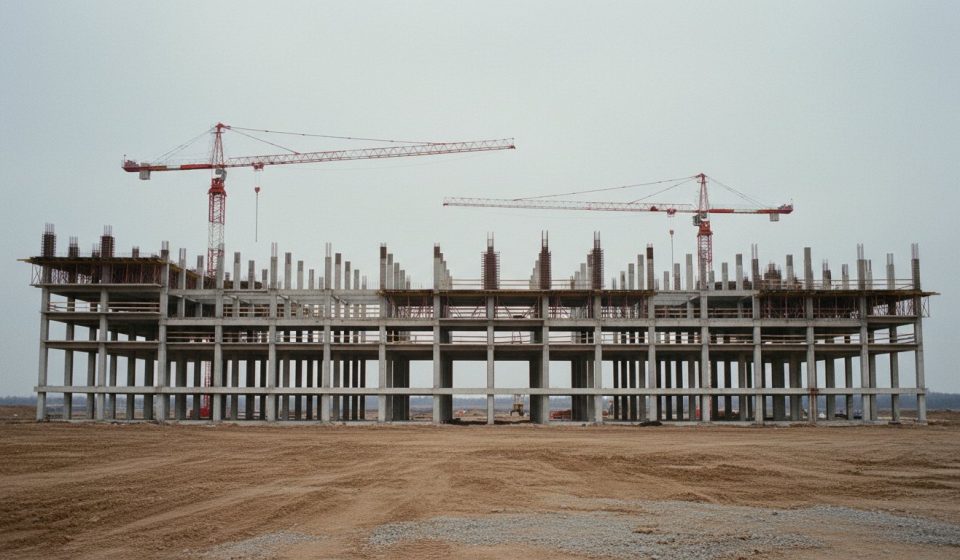

The Boom Has a Date of Death
American factory construction spending peaked in August 2024, at a revised seasonally adjusted annual rate of $249.8 billion. It has been falling since.
The Census Bureau’s release of 3 August 2026 puts June at a $172.674 billion annual rate — down 21.4% from $219.564 billion a year earlier. May came in at $174.8 billion. Those two readings together describe a market cooling steadily rather than falling off a cliff, which is the more useful characterisation and the less dramatic one.
For scale on what is unwinding: full-year 2024 manufacturing construction ran at $235.6 billion, after climbing more than 200% in three years. This was the largest factory-building cycle in modern American history, and the descent from it is now well established.
It Is Not a Broad Manufacturing Slump
The headline number invites a story about American industry retrenching. The composition says something narrower.
The decline is concentrated almost entirely in semiconductor and electronics facilities, where spending has fallen roughly 44% from its mid-2024 peak. At that peak, this one sector accounted for more than half of all manufacturing construction spending in the United States. A category that large, falling that far, is sufficient to produce the headline on its own.
That distinction changes what the number means. A 21% decline spread evenly across food processing, machinery, chemicals and electronics would describe a manufacturing economy pulling back. A 21% decline driven by one CHIPS-era category normalising describes something closer to a construction cycle completing.
Why It Was Always Going to Fall
The mechanism is unremarkable once stated plainly, and it is the reason this was predictable.
Construction spending measures money going into the ground, not capacity coming out of it. A fab announced in 2022 books its heaviest spending during the shell-and-cleanroom phase, then tapers sharply as it moves into tool installation and commissioning. As FMI’s analysts have put it, the semiconductor fabs and battery plants that started between 2022 and 2024 are moving past their heavy-spending construction phases, and few new projects at a similar scale are starting behind them.
So the spending curve falls even as the productive capacity those projects represent is still arriving. The fabs are not cancelled. They are being finished.
This is the trap in reading construction spending as an industrial health indicator. It is a leading indicator of future capacity and a lagging indicator of past policy — the CHIPS Act and the Inflation Reduction Act were passed in 2022, and 2024 was when the concrete for them was poured. What 2026 measures is the absence of a second wave of comparable scale, not the failure of the first.
What Would Make This Worse Than a Cycle
The reasonable worry is not the current decline. It is what follows it.
The projects rolling off were driven by two large, time-limited federal programmes. If nothing of similar magnitude replaces that demand, manufacturing construction does not return to its 2024 level — it settles at whatever private capital alone will fund, which is considerably lower. Forecasters currently expect total US construction spending to slip about 1.3% in 2026, with the manufacturing slump doing most of the dragging.
The other risk is compositional. If the electronics decline eventually stops and the aggregate keeps falling, that would mean weakness spreading into the sectors that were never subsidised. That has not happened yet, and it is the thing to watch for rather than assume.
What to Watch
- The electronics share of the total, not the total. As long as computer/electronic/electrical is doing the falling, this is a subsidised cycle normalising. When the non-electronics categories start declining, the story changes.
- Announced project starts at $1 billion and above. Spending follows starts by roughly a year. A thin start pipeline in late 2026 sets the 2027 floor.
- Capacity coming online versus spending going down. These move in opposite directions by design. Fab output ramping through 2027 while construction spending falls is the expected pattern, not a contradiction.
If you use this series for anything operational — siting, contracting, industrial equipment demand — the practical adjustment is to stop reading the aggregate. Pull the Census detail and split electronics out from everything else. One line is a policy cycle unwinding on schedule; the other is the actual condition of American manufacturing construction, and it is not doing the same thing.
Get the weekly briefing
One email a week on AI, infrastructure, policy and the supply chains underneath them. Free, and you can unsubscribe any time.